Posts

Showing posts with the label 16th Century

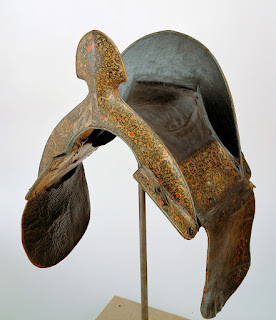
Turkish Saddle, AD 1550 - Türk Eyeri, M.S. 1550
Image
Turkish Saddle,  AD 1550  Turkish Saddle made of wood, parchment, lacquer painting, felt, deerskin and red velvet, dated ca 1550. This Turkish saddle, probably war booty of Archduke Ferdinand I (1503-1564) comes from the Ambras Castle. Türk Eyeri, M.S. 1550 Yaklaşık 1550 yılına tarihlenen ahşap, parşömen, lake boyama, keçe, geyik derisi ve kırmızı kadifeden imal edilmiş Türk Eyeri.  Muhtemelen Archduke I. Ferdinand’ ın (1503-1564) savaş ganimeti olan bu Türk eyeri Ambras Kalesi'nden gelmektedir.

Yatagan from the Court of Sultan Suleyman "Suleiman" the Magnificent, ca 1520-30

Image
Turkish Yatagan Turkish Yatagan (Short Sword) from the Court of Sultan Suleyman Khan the Magnificent (Reigned 1520–66). Made of Steel, gold, ivory (walrus), silver, turquoise, pearls and rubies. Almost identical to a Yatagan (now in the Topkapi Palace) made in 1526–27 by the court jeweller Ahmed Tekeli, for Sultan Süleyman Khan the Magnificent. Dated ca 1520-30, Length 59,3 cm. Weight 691 g. The Yatagan is a type of Turkish short sabre which differentiates by a single-edged blade that curves slightly inward and by a hilt with no guard. Türk Yatağan Kanuni Sultan Süleyman Han'ın sarayından, çelik, altın, fildişi (mors), gümüş, turkuvaz, inci ve yakut dan yapılmış Türk Yatağanı (Kısa Kılıç). Kanuni Sultan Süleyman Han (Saltanatı 1520-66) için saray kuyumcusu Ahmet Tekeli tarafından 1526-27 arasında yapılan (şimdi Topkapı Sarayı'nda) bir diğer Yatağan ile hemen hemen aynıdır. Uzunluk 59,3 cm. Ağırlık 691 g, yaklaşık 1520-1530 tarihli. Yatağan hafif içe kıv...

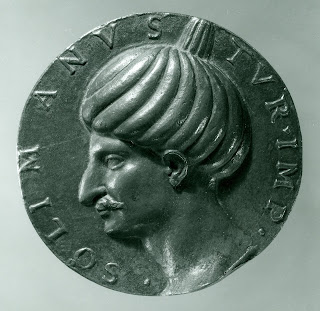
Sulaiman "Süleyman", Turkish Emperor (1520–1566)

Image
Medal of Sultan Sulaiman Khan the Magnificent  Sulaiman, Turkish Emperor (1520–1566). The bronze medal of Sultan Sulaiman Khan the Magnificent  (1494-1566), Northern Italian, 1525. Diameter: 12,8 cm.  Inscription :  “• SOLIMANVS• TVR• IMP•”, SOLYMANVS TVR[carum] IMP[erator], (Sulaiman, Turkish Emperor ).  Kanuni Sultan Süleyman Han Madalyonu Süleyman Türk İmparatoru (1520–1566).  Bronz Kanuni Sultan Süleyman Han (1494-1566) madalyonu. Kuzey İtalya, 1525. Çap: 12,8 cm.  Yazıt :  “• SOLIMANVS• TVR• IMP•”,  SOLYMANVS TVR[carum] IMP[erator], ( Süleyman, Türk İmparatoru)

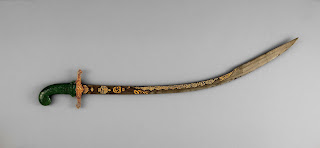
Turkish Saber "Kilij", 16th century.

Image
Turkish Kilij Turkish Kilij (Kılıç, literally "sword") from 16th century. The sword is made of watered steel, with jade grip, golden guard and decorated with inscripitions, gold and ruby.  A “Kilij” is a type of one-handed, single edged and moderately curved saber used by the Turks throughout history starting from the Hsiung-nu period. The Turkish root verb "kır-" means "to break" with the suffix "-inç" makes "kır-ınç" (instrument for breaking) becomes kılınç, then kılıç. Türk Kılıcı 16. yüzyıla ait Türk Kılıcı. Kılıç çifte su verilmiş çelikten yapılmış olup, yeşim taşı kabzalı, altın balçaklıdır, altın kakma yazı ve yakutlarla süslenmiştir. Kılıç, Asya Hunları döneminden başlayarak tarih boyunca Türkler tarafından kullanıla gelmiş, tek elle kullanılan, tek tarafı kesin, hafif kavisli bir süvari silahıdır. Türkçe “kır” fiilinin kök olduğu kelime “ınç” soneki ile “kır-ınç” (kırmak için alet) şeklinde türetilmiş, za...

Gold Coin of Yavuz Sultan Selim Khan (1512-1520)

Image
Ottoman Dynasty Gold Coin "Sultani" The Sultani, (Ottoman Dynasty Gold Coin) minted by Yavuz Sultan Selim Khan (1512-1520) in Istanbul, 19 mm x 3.42 grams, dated 1512/1513. Sultani is the classic Ottoman Dynasty gold coin also known generically as altın ("gold").  Inscriptions on the obverse; In Arabic:  “Darib-ün nadri sahib-ül izzi ven-nasri  filberri vel-bahr.”   English Tranlation:  “Striker of the Glittering, Master of might and victorious of land and the sea.”  Inscriptions on the reverse; In Arabic:  “Sultan Selim Sah bin Bayezid Han azze nasruhû duribe Kostantiniyye 918.”  English Translation:  “Shah Sultan Selim Son of Bayazid Khan, may his victory be glorious, struck in Constantinople 918.” Obverse of the Sultani Reverse of the Sultani Osmanlı Hanedanı Altın Sikke "Sultani" Yavuz Sultan Selim Han (1512-1520) tarafından İstanbul’da bastırılan 1512/1513 tarihli Sultani ...

Map of Turkia and Turkish Empire, 1593 Antwerp

Image
Map of Turkia and Turkish Empire Turcia Turci Cive Imperii (Turkia and Turkish Empire) 1593 Antwerp, Gerard De Jode (1509–1591). The map of Turkey and Turkish Empire from the 1593 edition of Gerard De Jode's “Speculum Orbis Terrarum” published by his son Cornelis.  The map includes two title cartouches and three sailing ships. Noah's Ark appears on Mount Ararat. The upper cartouche indicate the geographical information “Natoliam modern, dicunt eam partem quam Asiam Minorem apellavere veteres” the lower cartouche “Turcia Turci Cive Imperii” indicate that it is a map of Turkia and Turkish Empire.  Türkiye ve Türk İmparatorluğu Haritası Turcia Turci Cive Imperii (Türkiye ve Türk İmparatorluğu) 1593 Anvers, Gerard De Jode (1509–1591). Gerard De Jode’un “Speculum Orbis Terrarum” atlasının oğlu Cornelis tarafından yayınlanan 1593 yılı baskısından Türkiye ve Türk İmparatorluğu haritası. İki ayrı kitabe ve üç yelkenli geminin yer aldığı harita Nuh'un Gemisini...

A variation of Ortelius's map of the Turkish Empire

Image
Turcici Imperii Descriptio  “Turkish Empire Description”  ORTELIUS Abraham (1527 - 1598), Antwerp 1581   A variation of Ortelius's map of the Turkish Empire from “Theatrum Orbis Terrarum” the first modern atlas of the world with a different cartouche. The map is based upon Gastaldi's wall map of Asia. Includes an ornate cartouche, four sailing vessels and a sea monster in the Black Sea. This second edition of the map was published from 1579 onward, with a distinctly different cartouche, but unchanged cartographic features.  Turcici Imperii Descriptio  “Türk İmparatorluğu Tasviri” Abraham ORTELIUS (1527 - 1598), Anvers 1581 İlk modern dünya atlası sayılan Ortelius’un  "Theatrum Orbis terrarum" atlasından, ilk baskısından farklı bir kitabeye sahip Türk İmparatorluğu haritası varyasyonu. Harita Gastaldi’nin, Asya duvar haritası temel alınarak  hazırlanmıştır. Süslü bir kitabeye sahip olan haritada dört yelkenli gemi ve ...

Turkish Saddle, 16th Century

Image
Turkish Saddle Turkish Saddle, late 16th Century. Made of wood, staghorn, bark, leather, textile, iron and pigment with the use of pierced leather decoration appliquéd on different colored grounds. Dimensions: Height 57,8 cm. Width 61 cm. Weight 4130 g. Türk Eyeri Geç 16. yüzyıla ait Türk Eyeri. Ahşap, geyik boynuzu, ağaç kabuğu, deri, kumaş, demir ve boyadan, işlenerek dekore edilmiş derinin farklı renklerde zemin üzerine aplikasyonu yöntemi ile imal edilmiştir. Boyutlar: Yükseklik 57,8 cm. Genişlik 61 cm. Ağırlık 4130 gr.

Horse's Head Armour "Chamfron" stamped with the Kayı Tamga

Image
Turkish Horse's Head Armour "Chamfron" Turkish, Tombak (Copper alloy), Chamfron (Horse's Head Defense) stamped with the Kayı tribe Tamga, 16th century. Height: 59, 06 cm. Width: 22, 23 cm. Weight: 1917 g. This tombak, chamfron was intended for ceremonial use, as Turkish battle armour for both horse and rider was generally fabricated of steel. A tamgha (stamp, seal) is an abstract seal used by the Turks as the emblem of a particular tribe. The KAYI tribe (Turkish: Kayı boyu) is a sub-branch of the BOZOK Tribal federation of OGHUZ Turks. Osman I, founder of Ottoman Dynasty was a hereditary leader in the Kayı tribe. Royal arsenal of the Ottoman Dynasty (Cebehane) used Kayı Tamga as it’s distinctive mark on every kind of weaponry. Türk At Alın Zırhı Kayı boyu damgası vurulmuş, Türk, Tombak, At başı zırhı, 16. Yüzyıl. Yükseklik: 59,06 cm. Genişlik: 22,23 cm. Ağırlık: 1917 gr. Bu tombak, at alın zırhı törensel kullanıma yönelikti zira hem at...

Archer's Thumb Ring "Zihgir" 16th century

Image
Turkish Zihgir Turkish archer's Thumb Ring (Zihgir) made of nephrite, gold, diamonds and rubies , 16 th century. Turkish archers shot with thumb releases. “Zihgir” is a piece of equipment designed to protect the thumb and aid the draw during archery. Turkish thumb rings were made of wood, metal, ivory, bone, horn or leather. These rings signified that the person wearing them was a warrior. Türk Zihgir Yeşim taşı, altın, zümrüt ve yakuttan yapılmış Türk Zihgir (şast veya okçu yüzüğü), 16. – 17. Yüzyıl. "Zihgir" okçuluk sırasında başparmağı korumak ve yay çekişine destek olmak için tasarlanmış bir donanım parçasıdır. Türk zihgirleri ahşap, metal, fildişi, kemik, boynuz ya da deriden yapılırdı. Bu yüzükler onları takan kişinin bir savaşçı olduğuna delalet ederdi.