Posts

Showing posts with the label Ottoman dynasty

MEHMED II The Conqueror, Sultan of the TURKS
Image
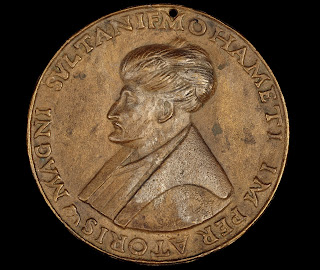
Medal of  Sultan Mehmed Khan II MEHMED II Sultan of the TURKS. The Bronze Medal of  Sultan Mehmed Khan II  (1432 – 1481),  made by Gentile Bellini, Venice 1480, diameter: 9.2 cm.  Inscriptions on the obverse:  “MAGNI SVLTANIFMOHAMETI IMPERATORIS”  (The Great Sultan Mehmed Emperor) Inscriptions on the reverse:   “GENTILIS BELLINVS VENETVS EQVES AVRATUS COMES . Q[ue] . PALATINVS . F[ecit] . ”  (Gentile Bellini, Venetian, gilded knight and count palatine, made it)   Obverse Reverse Fatih Sultan Mehmet Han Madalyonu Fatih Sultan Mehmet, TÜRKLERİN Sultanı. Gentile Bellini tarafından yapılan bronz Fatih Sultan Mehmet Han (1432 – 1481) madalyonu, Venedik 1480, çap: 9.2 cm.  Ön yüzdeki y azıtlar:  “MAGNI SVLTANIFMOHAMETI IMPERATORIS”  (Büyük Sultan Mehmed, İmparator) Arka yüzdeki yazıtlar: “GENTILIS BELLINVS VENETVS EQVES AVRATUS COMES . Q[ue] . PALATINVS . F[ec...

Sultan Orchan "Orhan" Khan (1281 – 1362)

Image
Sultan Orchan Khan Sultan Orchan Khan (1281 – 1362) from "Portraits of the Emperors of Turkey" - London, 1815 by  John Young. This sheet shows the second sultan of the Ottoman dynasty, Sultan Orchan Khan, Orchan "Orhan" reigned from 1326 to 1360, spending most of his time on the battlefield. He acquired the Dardanelles and areas around Constantinople, established longstanding military protocols and costumes, and was the first Ottoman dynasty sultan to mint coins in his own name. The vignette below records an event which, according to Ottoman writers, forms a striking epoch in Turkish history; namely, the first passage of Turks over the Hellespont into Europe, under Soliman, the son Orchan. The invading army, after walking over the ruins of Troy, embarked near Abydos. Sultan Orhan Han "Orhan Gazi" Sultan Orhan Han (1281 – 1362) “Türkiye'nin İmparatorlarının Portreleri” (Portraits of the Emperors of Turkey) - London, 1815  John You...

Sultan Othman "Osman" Khan the first (1258 – 1326)

Image
Sultan Othman Khan I Sultan Othman Khan the first (1258 – 1326) from Portraits of the Emperors of Turkey - London, 1815 by  John Young. Sultan Selim III commissioned English engraver John Young (1755- 1825) to make a series after portraits of the emperors of Turkey before 1807, but production halted when janissaries assassinated the sultan. Mahmoud II ascended the throne, and John Young resumed work in 1810. This sheet shows the founder of the Ottoman dynasty, Othman (Osman) the first. He reigned from 1299 to 1326 and was said to be a great tactician known for his stern demeanor. The vignette below represents Othman in his camp, sitting under an imperial canopy, attended by his courtiers, and issuing orders to his officers. Sultan I. Osman Han "Osman Gazi" Sultan I. Osman Han (1258 - 1326) “Türkiye'nin İmparatorlarının Portreleri” (Portraits of the Emperors of Turkey) - London, 1815,  John Young. Sultan III. Selim Han 1807 öncesinde Türkiye'n...

The tomb "Türbe" of Ertuğrul Bey Ghazi

Image
The tomb of Ertuğrul Bey Ghazi The tomb of Ertuğrul Bey Ghazi, Söğüt, Bilecik, Turkiye. The tomb belongs to Ertuğrul Ghazi (1198 – 1281), the Bey (Leader) of Kayı of Oghuz, a fore Ruler of the Seljuk dynasty and the father of Osman Ghazi (Osman I) who is the founder of the Ottoman dynasty. The tomb is in town of Söğüt with in the borders of Bilecik province and is built in 14th century but the actual building date is unknown. Söğüt has been handed out to Ertuğrul Ghazi  in exchange for his services by Sultan Alaad-Din Kay Qubadh the first of the Seljuks. It is assumed that  the tomb has been built with the orders by his great grandson Chelebi Sultan Mehmet Khan the first. It has been restored in 1886 by Sultan the second Abdulhamid Khan.      Ertuğrul Bey Gazi Türbesi   Ertuğrul Bey Gazi Türbesi, Söğüt, Bilecik, Türkiye. Oğuzların Kayı boyu Beyi, Selçuklu hanedanı dönemi Uç Beyi ve Osmanlı hanedanının kurucusu Osman Bey Gazinin babas...

Charles V and Sultan Suleiman Khan the Magnificent

Image
Uniface bronze medal of Charles V and Sultan Suleiman Khan the Magnificent Charles V, supported by an angel and haunted by Sultan Suleiman Khan the Magnificent. Uniface bronze medal, anonymous, Netherlands, 1532 (?). Diameter: 108 mm. Inscriptions:  “+TE DECET O FELIX VLTRA PLVS PERGERE CESAR/CESAREO PRESENS DECIDET ENSE CAPVT” (It befits you, o fortunate Cesar, to proceed “plus ultra”/The present head will fall by the imperial sword) Kral Karlos ve Kanuni Sultan Süleyman Han Madalyonu Kanuni Sultan Süleyman Han tarafından musallat olunan ve bir melek tarafından desteklenen V. Şarl (Karlos Kral). Tek yüzlü bronz madalyon, anonim, Hollanda, 1532 (?). Çap: 108 mm. Yazıtlar:  “+TE DECET O FELIX VLTRA PLVS PERGERE CESAR/CESAREO PRESENS DECIDET ENSE CAPVT” (Sana yaraşır, ey talihli Sezar, ilerlemek “daha ilerisi”/ Mevcut kafa imparatorluk kılıcıyla düşecek)

A Jereed "Cirit" Game, 1891

Image
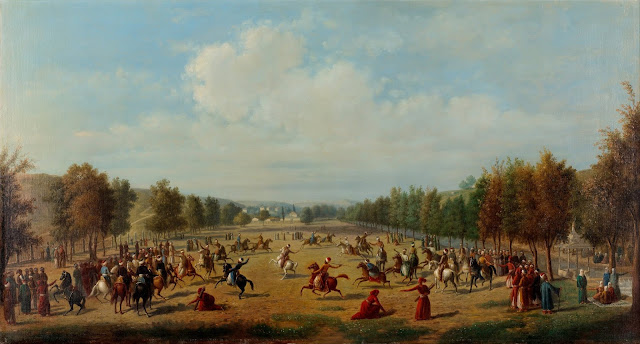
A Jereed Game in Kağıthane A Jereed Game in Kağıthane, Luigi Acquarone (from Antoine Ignace Melling) Oil on canvas, 65.5 x 120 cm, 1891. This painting by Acquarone, is an oil copy of the engraving Kağıthane, published in Melling’s book. Jereed “Cirit” is a traditional Turkish equestrian war game played by Turks trough out history. Mainly, jereed was played to improve the cavalry’s attack and defence skills, and to whip up their enthusiasm for battle. Under Ottoman dynasty rule a superior class of cavalrymen known as "cündi" was formed from those skilled at jereed. Kâğıthane’de Cirit Kâğıthane’de Cirit, Luigi Acquarone (Antoine Ignace Melling’ten). Tuval üstüne yağlıboya, 65,5×120 cm, 1891. Acquarone'nin bu tablosu, Melling’in kitabında yayınlanan Kâğıthane gravürünün bir yağlıboya kopyasıdır. Cirit, Türklerin tarih boyunca oynadığı geleneksel bir Türk atlı savaş oyunudur. Esas olarak, süvarinin saldırı ve savunma becerilerinin geliştirilmesi ve c...

Türckische Cammer “Turkish Chamber”

Image
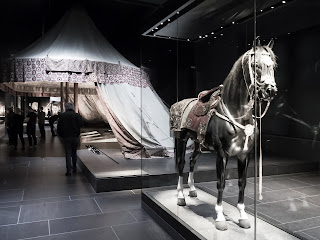
Türckische Cammer “Turkish Chamber” In the Dresden Residenzschloss  “Royal Palace” Armoury, Dresden State Art Collections The Türckische Cammer in Dresden is one of the most significant collections of Turkish art from Ottoman Dynasty period outside Turkey. Exhibition presents more than 600 individual pieces of Turkish art. The largest object is the three-mast Turkish tent brought to Dresden in 1730. This 20 m long, 8 wide and 6 m high tent gives the viewer a sense of being under a second sky of gold and silk. The tent is made of satin, cotton and gilt leather; its restoration lasted 14 years. In addition, there are eight life-sized, carved wooden horses and a group of Turkish bows with original strings, the oldest of which dates from 1586.  Also shown are weapons, chain mail armours, helmets, flags and costumes. Türckische Cammer "Türk Salonu" Dresden Residenzschloss “Kraliyet Sarayı” Silahhanesi, Dresden Eyalet Sana...