Posts

Showing posts with the label Turkish archery

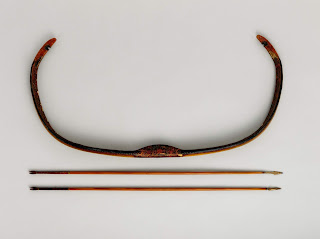
Turkish Bow & Arrows, A.D. 1719–20
Image
Turkish Bow Turkish Bow; Length 64,8 cm. Weight 365 g. A.D. 1719–20. The Turkish  bow is a recurved, composite bow used by the Turks throughout history which is made from horn, wood and sinew glued together.  Depending on the quality of the bow, it took up to ten years to manufacture the weapon.  Turkish archers shot with thumb releases. A thumb-ring was worn to protect the thumb and aid the draw.  With these composite bows, the Turks shot up to 800 meters.  Türk Yayı Türk Yayı; Uzunluk 64,8 cm. Ağırlık 365 gr. M.S. 1719-1720. Türk  yayı tarih boyunca Türkler tarafından kullanıla gelmiş, kıvrık  (uçbükümlü),  bir kompozit (Katışık) yaydır,  ahşap, boynuz ve hayvan kirişinin (tendon) birbirine tutkallanması ile üretilmiştir. Silahın üretimi yayın kalitesine bağlı olarak on yıl kadar alabiliyordu. Türk okçuları başparmak çekişi (Mandal) ile ok atarlardı. Başparmağı korumak ve yay çekişine destek olmak için zi...

Archer's Thumb Ring "Zihgir" 16th century

Image
Turkish Zihgir Turkish archer's Thumb Ring (Zihgir) made of nephrite, gold, diamonds and rubies , 16 th century. Turkish archers shot with thumb releases. “Zihgir” is a piece of equipment designed to protect the thumb and aid the draw during archery. Turkish thumb rings were made of wood, metal, ivory, bone, horn or leather. These rings signified that the person wearing them was a warrior. Türk Zihgir Yeşim taşı, altın, zümrüt ve yakuttan yapılmış Türk Zihgir (şast veya okçu yüzüğü), 16. – 17. Yüzyıl. "Zihgir" okçuluk sırasında başparmağı korumak ve yay çekişine destek olmak için tasarlanmış bir donanım parçasıdır. Türk zihgirleri ahşap, metal, fildişi, kemik, boynuz ya da deriden yapılırdı. Bu yüzükler onları takan kişinin bir savaşçı olduğuna delalet ederdi.

Set of Turkish Quiver, Bow case and Arrows

Image
Set of  Turkish Quiver, Bow case and Arrows Turkish Bow case “Sadak” and Quiver “Tirkeş” set. Made of, Leather with appliqués, silk threads, silk fabric and gold leaf, ca. 1550. The bow, which was stowed in the bow case, had become a symbol of Turkish armament alongside the Kilij. Depending on the quality of the bow, it took up to ten years to manufacture the weapon, with individual layers of wood, buffalo horn, and sinew (tendon) glued together with fish glue. Each of these operations required extensive drying times, resulting in the long manufacturing time. The Turkish army did not renounced this weapon even after the introduction of firearms. With these composite bows, the Turks shot up to 800 meters. In order to protect the bow from moisture, after use, it was stored in a Sadak, which was worn on the left side. Sadak also made it possible to stow the bow in close combat, as it was a hindrance. On the other hand a “Tirkeş” (Quiver) was a container for holding the arrows,...