Posts

Showing posts with the label 17 Yüzyıl

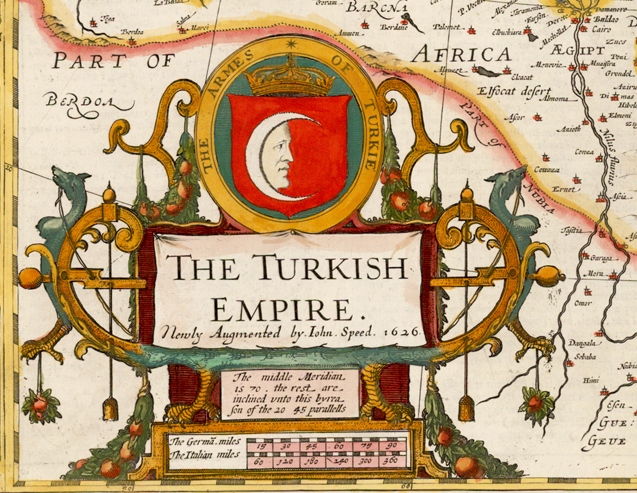
The Turkish Empire. The Armes of Turkie, London, 1626
Image
Map of the Turkish Empire The Turkish Empire, London 1626 John SPEED (1552-1629) One of the most decorative maps of the Turkish Empire issued in the 17th Century. The first map of the region published in England, decorated with eight Turkish town plan (Famagusta, Damascus, Cairo, Jerusalem, Constantinople, Rhodes, Alexandria and Ormus) and ten costumed figures and a large cartouche. Size 390 x 510 mm Türk İmparatorluğu Haritası Türk İmparatorluğu, Londra 1626, John SPEED (1552-1629) Türk İmparatorluğu'nun 17. yüzyılda yayınlanmış en dekoratif haritalarından biridir.  Sekiz Türk şehrinin planı, ( Mağusa, Şam, Kahire, Kudüs, İstanbul, Rodos, İskenderiye ve Hürmüz ) on kostümlü figür ve büyük bir kitabe ile süslenmiş 390 x 510 mm boyutlarındaki harita bölgenin İngiltere'de yayınlanan ilk haritasıdır.

Map of the Turkish Empire, Amsterdam 1606, Jodocus Hondius

Image
Turkish Empire Image Turcici Imperii Imago, Amsterdam 1606, Jodocus Hondius (1563 – 1612) Map of the Turkish Empire, showing the Turkish territories in the Balkans, Anatolia, Levant, Arabia and North Africa, published by  Hondius in "Atlas sive Cosmographicae Meditationes de Fabrica Mundi et Fabricati figura" (Atlas of the world: finely engraved and drawn) in 1606. The map has a decorative cartouche with the portrait of Sultan Mehmet Khan II which refers to him as "Sultan Mahomet Turcorum Imperat 2."   Türk İmparatorluğu Görünümü Turcici Imperii Imago, Amsterdam 1606, Jodocus Hondius (1563-1612).  Balkanlar, Anadolu, Levant, Arabistan ve Kuzey Afrikadaki Türk topraklarını gösteren,Hondius’un “Atlas sive Cosmographicae Meditationes de Fabrica Mundi et Fabricati figura” (Dünyanın atlası: incelikle işlenmiş ve çizilmiş)  Dünya Atlasında 1606 yılında yayınlanan, Türk İmparatorluğu haritası. Fatih Sultan Mehmet Han’ nın bir portresi bulunan har...

Turkish Mace "Bozdoğan, Gürz" dated 1648–87

Image
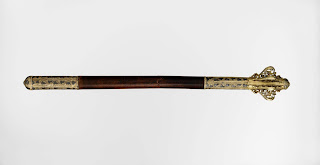
Mace (Bozdoğan, Gürz) Turkish Mace (Bozdoğan, Gürz), made of silver, copper alloy (niello), leather and wood, dated 1648–87. This delicately crafted silver-gilt mace, with tulip designs, was an insignia of command in the Turkish army. Length 60.96 cm, Weight 535 g. A mace is a weapon that uses a heavy knob on the end of a handle to deliver powerful blows. Türk  Topuz ( Bozdoğan,Gürz) Türk Bozdoğan (Gürz, Topuz), 1648-87 arası tarihli, gümüş, bakır alaşımları (Savat), deri ve ahşaptan yapılmış. Özenle hazırlanmış, gümüş kaplama, lale tasarımlı bu Gürz, Türk ordusunda komuta ve rütbe alametiydi.  Uzunluk 60.96 cm, Ağırlık 535 g. Bozdoğan (Gürz, Topuz), güçlü darbeler sağlamak için bir sapın ucunda ağır bir tokmak kullanılan bir silahtır.

Süleyman II, Louis XIV, Kaptan Pasha, James II

Image
Silver Medal; Süleyman II, Louis XIV, Kaptan Pasha, James II A Silver medal made by Dutch sculptor and medallist Jan Smeltzing (1656 - 1693) Netherlands, 1688. Diameter: 48 mm.  Inscriptions on the obverse;  “SOLIMAN . III . LUDOV . XIV . MEZOMORTO . IACOB . II.”  (Sultan Süleyman Khan II, Louis XIV, Mezamorto Hüseyin Pasha, James II),  “CONTRA. CHRISTI. ANISMUM”  (Against the spirit of Christ)  Inscription   on the reverse; “IN FŒDERE QUINTUS” (The fifth in the confederacy) 1688 Obverse Reverse Gümüş Madalyon; II. Süleyman, XIV. Lui, Hüseyin Paşa,  II. James Hollandalı heykeltıraş ve madalyoncu Jan Smeltzing (1656 -1693)  tarafından yapılan gümüş madalyon, Hollanda, 1688. Çap: 48 mm.  Yazıtlar ön yüz: “SOLIMAN . III . LUDOV . XIV . MEZOMORTO . IACOB . II.”  (Sultan 2. Süleyman Han, 14. Lui, Mezamorta Hüseyin Paşa, 2. James) “CONTRA. CHRISTI. ANISMUM”...

Turkish Kilij “Kılıç”, 17th century

Image
Turkish Kilij Turkish Kilij (Kılıç, literally "sword") from 17th century. Length 96,5 cm. Weight 889 g. The sword is made of watered steel, with jade (nephrite) grip, golden guard and decorated with inscripitions, gold and diamonds. A “Kilij” is a type of one-handed, single edged and moderately curved saber used by the Turks throughout history starting from the Hsiung-nu period. The Turkish root verb "kır-" means "to break" with the suffix "-inç" makes "kır-ınç" (instrument for breaking) becomes kılınç, then kılıç. Türk Kılıcı 17. yüzyıla ait Türk Kılıcı. Uzunluk: 96,5 cm Ağırlık: 889 g. Kılıç çifte su verilmiş çelikten yapılmış olup, yeşim taşı kabzalı, altın balçaklıdır, altın kakma yazı ve elmaslarla süslenmiştir. Kılıç, Asya Hunları döneminden başlayarak tarih boyunca Türkler tarafından kullanıla gelmiş, tek elle kullanılan, tek tarafı kesin, hafif kavisli bir süvari silahıdır. Türkçe “kır” fiilinin kök olduğu ...