Posts

Showing posts with the label Fatih

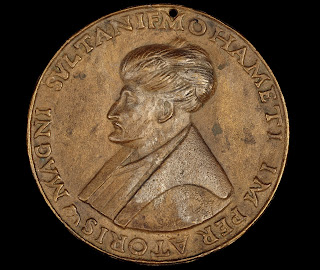
MEHMED II The Conqueror, Sultan of the TURKS
Image
Medal of  Sultan Mehmed Khan II MEHMED II Sultan of the TURKS. The Bronze Medal of  Sultan Mehmed Khan II  (1432 – 1481),  made by Gentile Bellini, Venice 1480, diameter: 9.2 cm.  Inscriptions on the obverse:  “MAGNI SVLTANIFMOHAMETI IMPERATORIS”  (The Great Sultan Mehmed Emperor) Inscriptions on the reverse:   “GENTILIS BELLINVS VENETVS EQVES AVRATUS COMES . Q[ue] . PALATINVS . F[ecit] . ”  (Gentile Bellini, Venetian, gilded knight and count palatine, made it)   Obverse Reverse Fatih Sultan Mehmet Han Madalyonu Fatih Sultan Mehmet, TÜRKLERİN Sultanı. Gentile Bellini tarafından yapılan bronz Fatih Sultan Mehmet Han (1432 – 1481) madalyonu, Venedik 1480, çap: 9.2 cm.  Ön yüzdeki y azıtlar:  “MAGNI SVLTANIFMOHAMETI IMPERATORIS”  (Büyük Sultan Mehmed, İmparator) Arka yüzdeki yazıtlar: “GENTILIS BELLINVS VENETVS EQVES AVRATUS COMES . Q[ue] . PALATINVS . F[ec...

The Hagia Sophia "Ayasofya" Istanbul

Image
The Hagia Sophia The Hagia Sophia (Greek: Ἁγία Σοφία, Latin: Sancta Sophia or Sancta Sapientia ) meaning "Holy Wisdom", is the biggest church constructed by the Roman Empire in Constantinople, it has been constructed three times in the same location. The current structure was constructed by Isidoros and Anthemios, who were renowned architects of their time, by Emperor Justinianos’s (527-565) orders. The third Hagia Sophia construction combined the traditional basilical plan with the central dome plan in design. During the Roman period, the Hagia Sophia was the Empire Church and, as a result, was the place in which the emperors were crowned. Following Fatih Sultan Mehmed Khan’s (1451-1481) conquer in 1453, Hagia Sophia was renovated into a mosque. The structure was fortified and was well protected and remained as a mosque. The Hagia Sophia was converted into a museum by Mustafa Kemal Atatürk’s orders and The Council of Ministers decision, it has been functioning as one si...

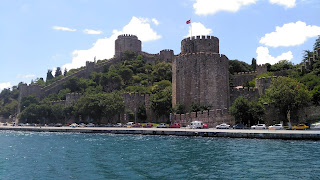
Rumelian Castle "Rumelihisarı", The Strait-Cutter

Image
Rumelian Castle "The Strait-Cutter" Rumelihisarı (Rumelian Castle) or Boğazkesen (literally meaning "the Strait-Cutter") is a fortress built by Sultan Mehmed Khan II, located at the European side and the narrowest point of the Bosphorus strait, just opposite of Anadoluhisarı (Anatolian Castle) on the Anatolian side. The construction began on 15 April 1452, the fortress was completed in a record time of 4 months and 16 days on 31 August 1452. The purposes of the structure were to manage the passing ships in the bosphorus, to create a military-financial control point, and to provide a strong fulcrum-resistance base.  The width of the castle walls was thrice the size of Constantinople, which was 2,5 m. The canon ball technology at  that period was insufficient to destroy this walls with a thickness of 7 m.  Rumeli Hisarı "Boğazkesen" Rumelihisarı ya da Boğazkesen İstanbul Boğazının Avrupa yakasında ve en dar noktasında tam Anad...

The Medal of Sultan Mehmed Khan II

Image
The Medal of  Sultan Mehmed Khan II the Conqueror   The Bronze Medal of  Sultan Mehmet Khan II the Conqueror (1432 – 1481),  made by Costanzo da Ferrara, Naples 1481, diameter: 12.3 cm. Inscriptions:  On the obverse, “SVITANVS . MOHAMETH . OTHOMANVS . TVRCORVM . IMPERATOR” (Sultan Mehmed of the house of Osman, emperor of the Turks); Obverse On the reverse, “HIC . BELLI . FVLMEN . POPVLOS . PROSTRAVIT . ET . VRBES” (This man, the thunderbolt of war, has laid low peoples and cities); in the tablet at the bottom of the reverse, “CONSTANTIVS . F”[ecit] (Costanzo made it) Reverse Fatih Sultan Mehmet Han Madalyonu Costanzo da Ferrara tarafından yapılan bronz Fatih Sultan Mehmet Han (1432 – 1481) madalyonu, Napoli 1481, çap:12.3 cm. Yazıtlar:  Ön yüzde, “SVITANVS MOHAMETH. OTHOMANVS. TVRCORVM. IMPERATOR” (Osmanlı hanedanından Sultan Mehmet, Türklerin imparatoru);  Arka yüzde, “HIC BELLI. FVLMEN. POPVLOS. PROSTRAVIT. ET VR...