Posts

Showing posts with the label İstanbul

Procession of the Sultan by Jean Baptiste Van Mour (1671-1737)

Image
The Turkish Sultan’s Procession The Turkish Sultan’s Procession in Istanbul. Painting by Jean Baptiste Van Mour (1671-1737). Jean Baptiste Vanmour or Van Mour was a Flemish-French painter, remembered for his detailed portrayal of life in the Turkish Empire during the Tulip Era and the rule of Sultan Ahmed Khan III. Türk Sultanının geçit töreni İstanbul'da Türk Sultanının geçit töreni. Jean Baptiste Van Mour  (1671-1737) tarafından yapılan resim. Jean Baptiste Vanmour ya da Van Mour, Lale Devri döneminde ve III. Sultan Ahmet Hanın saltanatı sırasında Türk İmparatorluğundaki yaşamı detaylandıran tasvirleri ile hatırlanan Flaman asıllı bir Fransız ressamdı.

The Hagia Sophia "Ayasofya" Istanbul

Image
The Hagia Sophia The Hagia Sophia (Greek: Ἁγία Σοφία, Latin: Sancta Sophia or Sancta Sapientia ) meaning "Holy Wisdom", is the biggest church constructed by the Roman Empire in Constantinople, it has been constructed three times in the same location. The current structure was constructed by Isidoros and Anthemios, who were renowned architects of their time, by Emperor Justinianos’s (527-565) orders. The third Hagia Sophia construction combined the traditional basilical plan with the central dome plan in design. During the Roman period, the Hagia Sophia was the Empire Church and, as a result, was the place in which the emperors were crowned. Following Fatih Sultan Mehmed Khan’s (1451-1481) conquer in 1453, Hagia Sophia was renovated into a mosque. The structure was fortified and was well protected and remained as a mosque. The Hagia Sophia was converted into a museum by Mustafa Kemal Atatürk’s orders and The Council of Ministers decision, it has been functioning as one si...

Rumelian Castle "Rumelihisarı", The Strait-Cutter

Image
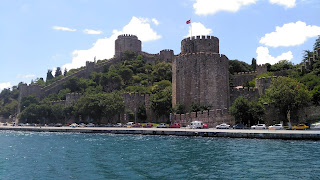
Rumelian Castle "The Strait-Cutter" Rumelihisarı (Rumelian Castle) or Boğazkesen (literally meaning "the Strait-Cutter") is a fortress built by Sultan Mehmed Khan II, located at the European side and the narrowest point of the Bosphorus strait, just opposite of Anadoluhisarı (Anatolian Castle) on the Anatolian side. The construction began on 15 April 1452, the fortress was completed in a record time of 4 months and 16 days on 31 August 1452. The purposes of the structure were to manage the passing ships in the bosphorus, to create a military-financial control point, and to provide a strong fulcrum-resistance base.  The width of the castle walls was thrice the size of Constantinople, which was 2,5 m. The canon ball technology at  that period was insufficient to destroy this walls with a thickness of 7 m.  Rumeli Hisarı "Boğazkesen" Rumelihisarı ya da Boğazkesen İstanbul Boğazının Avrupa yakasında ve en dar noktasında tam Anad...

The Fountain of Sultan Ahmed Khan, Istanbul

Image
The fountain of Sultan Ahmed The fountain of Sultan Ahmed, Istanbul, Turkey.  The fountain of Sultan Ahmed Khan (1673-1736) was built in 1728 by architect Ahmet Ağa, in the style of the Tulip period and located in the great square in front of the Imperial Gate of Topkapi Palace.    A photomechanical print published between ca. 1890 and ca. 1900 by Detroit Publishing Company. From the section of “Views of People and sites in Turkey” in the Photochrom (ink-based photolithographs) print collection of The Library of Congress.  Sultan Ahmet Çeşmesi Sultan Ahmet Çeşmesi, İstanbul, Türkiye.  Sultan Ahmet Han Çeşmesi (1673-1736) Mimar Ahmet Ağa tarafından 1728 yılında, Lale döneminin tarzında inşa edilmiş olup Topkapı Sarayı İmparatorluk Kapısı önündeki, büyük meydanda yer alır.  1890 ile 1900 yılları arasında Detroit Publishing Company tarafından yayınlanmış bir fotomekanik baskı. Kongre Kütüphanesi Photochrom (mürekkep tabanlı fotolitog...

A Jereed "Cirit" Game, 1891

Image
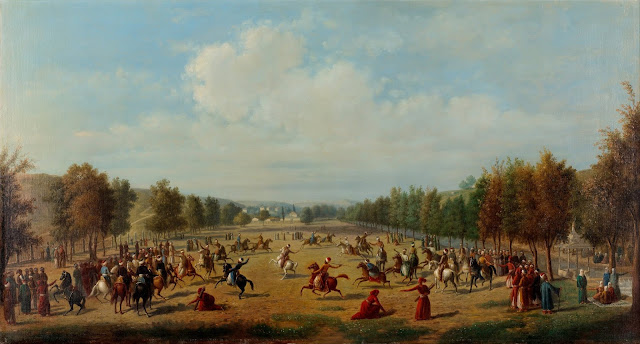
A Jereed Game in Kağıthane A Jereed Game in Kağıthane, Luigi Acquarone (from Antoine Ignace Melling) Oil on canvas, 65.5 x 120 cm, 1891. This painting by Acquarone, is an oil copy of the engraving Kağıthane, published in Melling’s book. Jereed “Cirit” is a traditional Turkish equestrian war game played by Turks trough out history. Mainly, jereed was played to improve the cavalry’s attack and defence skills, and to whip up their enthusiasm for battle. Under Ottoman dynasty rule a superior class of cavalrymen known as "cündi" was formed from those skilled at jereed. Kâğıthane’de Cirit Kâğıthane’de Cirit, Luigi Acquarone (Antoine Ignace Melling’ten). Tuval üstüne yağlıboya, 65,5×120 cm, 1891. Acquarone'nin bu tablosu, Melling’in kitabında yayınlanan Kâğıthane gravürünün bir yağlıboya kopyasıdır. Cirit, Türklerin tarih boyunca oynadığı geleneksel bir Türk atlı savaş oyunudur. Esas olarak, süvarinin saldırı ve savunma becerilerinin geliştirilmesi ve c...

Museum of Ancient Turkish Costumes of Constantinople

Image
Elbicei Atika  Musée des Anciens Costumes Turcs de Constantinople "Museum of Ancient Turkish Costumes of Constantinople"       Old TURKISH Military Illustrations from “Elbicei Atika. Musée des Anciens Costumes Turcs de Constantinople par Jean Brindesi” (Museum of Ancient Turkish Costumes of Constantinople by Jean Brindesi). The lithographic album consist of 22 plate depicting various Turkish functionaries and military personnel in their traditional costumes, published by Lemercier, Paris, 1850.        Plate 01; The Sultan (Sultan Mahmoud II), Minister of the Interior (Ministre de l'intérieur), Grand Vizier (Grand-Vizir)     Elbise-i Atika Musée des Anciens Costumes Turcs de Constantinople "İstanbul Eski Türk Kıyafetleri Müzesi"     “Elbicei Atika. Musée des Anciens Costumes Turcs de Constantinople par Jean Brindesi” (İstanbul Eski Türk Kıyafetleri Müzesi, Jean Brindesi...