Posts

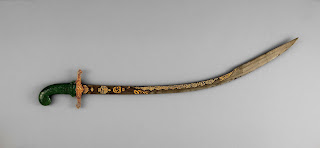
Turkish Yatagan "Yatağan" with Scabbard, 1802-1803

Image
Yatagan with Scabbard Turkish Yatagan with Scabbard (Yatağan ve Kın), dated 1802-1803.  Made of Steel, silver, gold and coral; Length 73,7 cm. Weight 737,1 g. The Yatagan or Yataghan is a type of Turkish short saber which differentiate by a single-edged blade that curves slightly inward and by a hilt with no guard and two flared wings at the pommel. Yatağan ile Kını Türk Yatağanı ve kını, 1802-1803 tarihli. Çelik, gümüş, altın ve mercandan yapılmış; Uzunluk 74,3 cm. Ağılık 737,1 gr. Yatağan hafif içe kıvrımlı ve tek tarafı keskin yalımı, balçaksız kabzası ve iki kulaklı topuzu ile ayırt edilen kısa bir Türk kılıç türdür.
Squadron of soldiers of the Ertugrul "Ertuğrul" Cavalry Regiment

Image
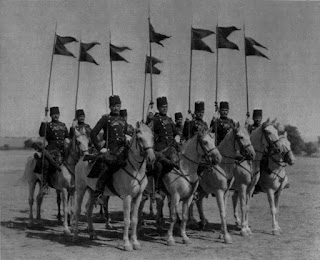
Ertugrul Cavalry Regiment   Squadron of soldiers of the Ertuğrul Cavalry Regiment of the Imperial Guard, Istanbul.  From Abdulhamid II Photograph collection, photographed by Abdullah Brothers between 1880 and 1890, Istanbul. Abdulhamid II collection is a monumental photograph collection that portrays Turkey during the reign of Sultan Abdulhamid Khan II.           Ertuğrul Süvari Alayı   İmparatorluk Muhafızları, Ertuğrul süvari alayından bir bölük asker, İstanbul.  2. Abdülhamit fotoğraf koleksiyonuna ait fotoğraf, Abdullah Biraderler tarafından 1880 ile 1893 arasında İstanbul’da çekilmiştir. Abdülhamit II koleksiyonu, Sultan Abdülhamit Han dönemindeki Türkiye'yi canlandıran anıtsal bir fotoğraf koleksiyonudur.      

Turkish Saber "Kilij", 16th century.

Image
Turkish Kilij Turkish Kilij (Kılıç, literally "sword") from 16th century. The sword is made of watered steel, with jade grip, golden guard and decorated with inscripitions, gold and ruby.  A “Kilij” is a type of one-handed, single edged and moderately curved saber used by the Turks throughout history starting from the Hsiung-nu period. The Turkish root verb "kır-" means "to break" with the suffix "-inç" makes "kır-ınç" (instrument for breaking) becomes kılınç, then kılıç. Türk Kılıcı 16. yüzyıla ait Türk Kılıcı. Kılıç çifte su verilmiş çelikten yapılmış olup, yeşim taşı kabzalı, altın balçaklıdır, altın kakma yazı ve yakutlarla süslenmiştir. Kılıç, Asya Hunları döneminden başlayarak tarih boyunca Türkler tarafından kullanıla gelmiş, tek elle kullanılan, tek tarafı kesin, hafif kavisli bir süvari silahıdır. Türkçe “kır” fiilinin kök olduğu kelime “ınç” soneki ile “kır-ınç” (kırmak için alet) şeklinde türetilmiş, za...

MEHMED II The Conqueror, Sultan of the TURKS

Image
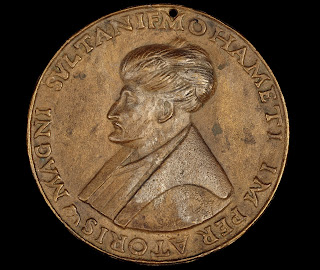
Medal of  Sultan Mehmed Khan II MEHMED II Sultan of the TURKS. The Bronze Medal of  Sultan Mehmed Khan II  (1432 – 1481),  made by Gentile Bellini, Venice 1480, diameter: 9.2 cm.  Inscriptions on the obverse:  “MAGNI SVLTANIFMOHAMETI IMPERATORIS”  (The Great Sultan Mehmed Emperor) Inscriptions on the reverse:   “GENTILIS BELLINVS VENETVS EQVES AVRATUS COMES . Q[ue] . PALATINVS . F[ecit] . ”  (Gentile Bellini, Venetian, gilded knight and count palatine, made it)   Obverse Reverse Fatih Sultan Mehmet Han Madalyonu Fatih Sultan Mehmet, TÜRKLERİN Sultanı. Gentile Bellini tarafından yapılan bronz Fatih Sultan Mehmet Han (1432 – 1481) madalyonu, Venedik 1480, çap: 9.2 cm.  Ön yüzdeki y azıtlar:  “MAGNI SVLTANIFMOHAMETI IMPERATORIS”  (Büyük Sultan Mehmed, İmparator) Arka yüzdeki yazıtlar: “GENTILIS BELLINVS VENETVS EQVES AVRATUS COMES . Q[ue] . PALATINVS . F[ec...

“Cheval Turc” Turkish Horse

Image
Turkish Horse “Cheval Turc” Turkish Horse, left foot raised. Bronze sculpture made by Antoine-Louis Barye (1796–1875) Height 30, 2 cm. Length 28, 9 cm. Paris 19th century, probably before 1847. Türk Atı “Cheval Turc” Türk atı, sol ayağı havada. Antoine-Louis Barye (1796–1875) tarafından yapılmış bronz heykel, Yükseklik 30, 2 cm. Uzunluk 28. 9 cm. Paris 19. Yüzyıl, muhtemelen 1847 öncesi.

The Hagia Sophia "Ayasofya" Istanbul

Image
The Hagia Sophia The Hagia Sophia (Greek: Ἁγία Σοφία, Latin: Sancta Sophia or Sancta Sapientia ) meaning "Holy Wisdom", is the biggest church constructed by the Roman Empire in Constantinople, it has been constructed three times in the same location. The current structure was constructed by Isidoros and Anthemios, who were renowned architects of their time, by Emperor Justinianos’s (527-565) orders. The third Hagia Sophia construction combined the traditional basilical plan with the central dome plan in design. During the Roman period, the Hagia Sophia was the Empire Church and, as a result, was the place in which the emperors were crowned. Following Fatih Sultan Mehmed Khan’s (1451-1481) conquer in 1453, Hagia Sophia was renovated into a mosque. The structure was fortified and was well protected and remained as a mosque. The Hagia Sophia was converted into a museum by Mustafa Kemal Atatürk’s orders and The Council of Ministers decision, it has been functioning as one si...

Sultan Orchan "Orhan" Khan (1281 – 1362)

Image
Sultan Orchan Khan Sultan Orchan Khan (1281 – 1362) from "Portraits of the Emperors of Turkey" - London, 1815 by  John Young. This sheet shows the second sultan of the Ottoman dynasty, Sultan Orchan Khan, Orchan "Orhan" reigned from 1326 to 1360, spending most of his time on the battlefield. He acquired the Dardanelles and areas around Constantinople, established longstanding military protocols and costumes, and was the first Ottoman dynasty sultan to mint coins in his own name. The vignette below records an event which, according to Ottoman writers, forms a striking epoch in Turkish history; namely, the first passage of Turks over the Hellespont into Europe, under Soliman, the son Orchan. The invading army, after walking over the ruins of Troy, embarked near Abydos. Sultan Orhan Han "Orhan Gazi" Sultan Orhan Han (1281 – 1362) “Türkiye'nin İmparatorlarının Portreleri” (Portraits of the Emperors of Turkey) - London, 1815  John You...

Turban Helmet with Aventail "Peçelikli Miğfer", 15th century

Image
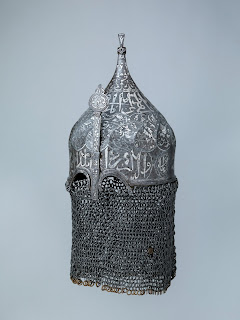
Turkish Turban Helmet Turkish Turban Helmet with Aventail (Peçelikli Miğfer), stamped with the Kayı Boyu Tamgha, late 15th century. This turban helmet retains the mail aventail that protected the lower half of the face and neck. The aventail is fixed with a lead seal stamped with the Kayı tribe Tamgha used in the Ottoman Dynasty arsenals. A tamgha (stamp, seal) is an abstract seal used by Turks as the emblem of a particular tribe. The KAYI tribe (Turkish: Kayı boyu) is a sub-branch of the BOZOK Tribal federation of OGHUZ Turks. Osman I, founder of Ottoman Dynasty was a hereditary leader in the Kayı tribe. Royal arsenal of the Ottoman Dynasty used Kayı Tamgha as it’s distinctive mark on every kind of weaponry. Türk Peçelikli Miğfer  Kayı Boyu damgası ile mühürlenmiş, Türk Peçelikli Miğfer (Tolga/Tulga), geç 15. yüzyıl. Bu miğferin yüzün alt kısmını ve boynu koruyan zincir zırh peçeliği halen mevcuttur. Peçeliğe Osmanlı hanedanı silahhanelerinin kullandığı K...

Gold Coin of Yavuz Sultan Selim Khan (1512-1520)

Image
Ottoman Dynasty Gold Coin "Sultani" The Sultani, (Ottoman Dynasty Gold Coin) minted by Yavuz Sultan Selim Khan (1512-1520) in Istanbul, 19 mm x 3.42 grams, dated 1512/1513. Sultani is the classic Ottoman Dynasty gold coin also known generically as altın ("gold").  Inscriptions on the obverse; In Arabic:  “Darib-ün nadri sahib-ül izzi ven-nasri  filberri vel-bahr.”   English Tranlation:  “Striker of the Glittering, Master of might and victorious of land and the sea.”  Inscriptions on the reverse; In Arabic:  “Sultan Selim Sah bin Bayezid Han azze nasruhû duribe Kostantiniyye 918.”  English Translation:  “Shah Sultan Selim Son of Bayazid Khan, may his victory be glorious, struck in Constantinople 918.” Obverse of the Sultani Reverse of the Sultani Osmanlı Hanedanı Altın Sikke "Sultani" Yavuz Sultan Selim Han (1512-1520) tarafından İstanbul’da bastırılan 1512/1513 tarihli Sultani ...

Rumelian Castle "Rumelihisarı", The Strait-Cutter

Image
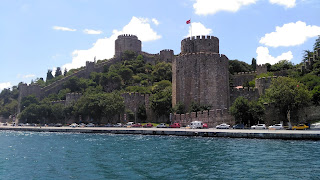
Rumelian Castle "The Strait-Cutter" Rumelihisarı (Rumelian Castle) or Boğazkesen (literally meaning "the Strait-Cutter") is a fortress built by Sultan Mehmed Khan II, located at the European side and the narrowest point of the Bosphorus strait, just opposite of Anadoluhisarı (Anatolian Castle) on the Anatolian side. The construction began on 15 April 1452, the fortress was completed in a record time of 4 months and 16 days on 31 August 1452. The purposes of the structure were to manage the passing ships in the bosphorus, to create a military-financial control point, and to provide a strong fulcrum-resistance base.  The width of the castle walls was thrice the size of Constantinople, which was 2,5 m. The canon ball technology at  that period was insufficient to destroy this walls with a thickness of 7 m.  Rumeli Hisarı "Boğazkesen" Rumelihisarı ya da Boğazkesen İstanbul Boğazının Avrupa yakasında ve en dar noktasında tam Anad...